
In a recent poll, a large number of UK high school teachers admitted that they self-censored their lessons, so as not to offend their thin-skinned Muslim students. No teacher in the U.K., or for that matter anywhere in Europe, has forgotten the beheading of Samuel Paty, the teacher who showed a cartoon of Muhammad in his class on free speech. Paty had warned students about what he was about to show in class that day, and told anyone who wished to leave the class could do so. One Muslim girl who bowed out nonetheless told her father, who began a campaign online against Paty. The father also exchanged e-mails with a Chechen about Paty’s “blasphemy.” The 19-year-old Chechen Muslim, who arrived from elsewhere in France, was determined to punish the “blaspheming” teacher. He came up to Paty as he walked home from school, and decapitated him. More on this story can be found here.
Teachers across the UK are self-censoring their lessons over fears of offending Muslim pupils, according to a recent poll.
A survey of over 1,000 teachers conducted for the Policy Exchange think tank found that 16 per cent of them have admitted to self-censoring in order to avoid causing religious offence.
The think tank claims this has created a “de facto blasphemy code in schools across the country”.
Fear of Muslim students and their families has led to self-censorship by teachers, now steering clear of anything that those students could consider “blasphemy” — such as unflattering depictions of Muhammad.
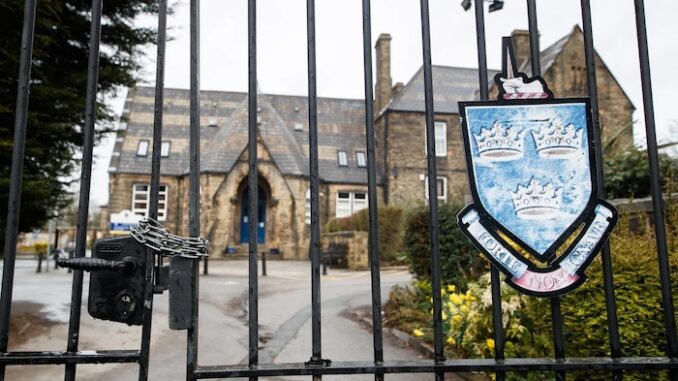
The poll comes after the Batley Grammar School incident, where campaigners and parents forced a teacher into hiding for showing a cartoon of the Prophet Mohammed in class.
English and art teachers were the most cautious of causing offence, with 19 per cent saying they had chosen to self-censor their classes.
English and art teachers are the most likely to give offense to Muslims, because of the nature of their subjects, An English — i.e., literature — teacher will run across unflattering descriptions or depictions of Muhammad, in such writers as Dante, Voltaire, Shakespeare, and Milton, and decide that the better part of valor would lead them to skip those authors’ anti-Muslim comments, no matter how glancing those comments may be.
And art teachers have to face the problem of whether or not to show depictions of Muhammad, as part of a syllabus segment on Islamic art, or to skip such a controversial subject altogether, because of the certainty that they will cause trouble among Muslim students. They may also be chary of discussing the Islamic prohibition on paintings or sculptures of living creatures.
Over half of teachers polled said that they would never use a picture of Prophet Mohammad whilst teaching, even when giving lessons on Islamic art or ethics.
A further 9 per cent cited the Batley incident as the reason for their caution.
At the Batley Grammar School, Muslim parents forced a teacher into hiding because he dared to show a cartoon of Muhammad in class. He immediately had a flood of death threats made against him; he is still in hiding, unable to teach, two years after the original threat against him was leveled.
In a foreword to the report, Nadhim Zahawi, the former education secretary, said it was a “national disgrace” that the teacher involved in the Batley incident was still in hiding two years later.
How can the teachers in the U.K. be made to feel safe enough to teach about the depictions of Muhammad in Islamic art without having to worry about the menace of death threats? Do they dare discuss anything truthful about Islamic conquests in their history or religion classes? And can they teach, without fearing the consequences, about the Crusades, and the Holocaust — two subjects that Muslim students angrily reject learning about?
One way might be to take a much tougher line on both Muslim students, and their parents, should they dare to complain about the classroom teaching. They don’t like a discussion of depictions of Muhammad in Islamic art as part of a course in art history? Then they may leave the classroom during the duration of that lesson if they wish. But if they or their parents menace a teacher who is teaching that material, they should immediately be charged with making threats of serious bodily harm, or even murder, and a judge should throw the book at them. A one-to-five year sentence for making such threats should concentrate Muslim minds wonderfully.
When it comes to teaching particular subjects such as, for example, the history of Islamic conquests, the Crusades, and the Holocaust, that Muslim students are known to resent, they should not be offered the possibility of opting out. As citizens or residents of the U.K., they must follow the Ministry of Education’s curriculum. They are not free to create a “Muslim-approved curriculum,” and through threats to teachers, impose it on others. A hard line needs to be taken; if Muslims don’t like what they are obligated to study, they are free to return to their countries of origin. Few will lament their leaving; many will be quite pleased.
by Hugh Fitzgerald